From "The
Buried Book - The Loss and Rediscovery of the Great Epic of Gilgamesh" by
David Damrosch
Having traced Gilgamesh back to the vanishing point of history, it may be appropriate to take leave of him where his ancient admirers were sure he would be found-in the House of Dust. Poems such as "The Descent of Inanna to the Underworld," as well as Enkidu's feverish dream in Gilgamesh, paint a compelling picture of the common final home of all humanity, awaiting everyone on earth.
This is how it would be to enter that realm. Having been led-or dragged-down the Road of No Return by the clawed hand of Humut-tabal, you pause, trying to catch the breath you no longer have, as Humut-tabal opens the massive outer door to the House of Dust. As he does so, you may see some odd-looking animals passing by. They are not large, emaciated dogs, as they first appear, but naked sheep: nothing grows in the underworld, so the sheep bear no wool. Shoved inside the doorway, you notice that the inside bolt is covered with dust. People come in through this door, but they never leave.
Though you are now inside what is called a house, it is really a complex of interlocking spaces, not unlike Sennacherib and Ashurbanipal's hundred-room palaces, though vastly larger. The harried scribe Belet-seri checks you off on her tablet, and then you make your way through a series of seven gates. At each gate, you are stripped of one of your garments; "In accordance with the ancient rules," the gate attendant brusquely tells you when you ask why. Deprived progressively of your breastplate, belt, robe, staff, tunic, armbands, and sandals, you finally arrive naked in a shadowy throne room. Receding into the distance along one end of this enormous room, lines of the dead are seated at long tables, eating. Most have to make do with lumps of clay, stale crusts of bread, and brackish water in place of beer. Some are better provided, since they are lucky enough to have children making proper offerings for them: a lesson that you sincerely hope your own children will not forget.
Enthroned at the far end of this room are Ereshkigal, queen of the Underworld, and her silent consort Nergal. Only Ereshkigal can release anyone from her eternal kingdom, but she spares no mortal man, woman, or child. When her own sister, Inanna, came down from heaven to visit her, Ereshkigal had her stripped naked just like everyone else and hung her rotting corpse from a meat hook on the wall, until the heavenly gods offered a ransom for her release. Perhaps Ereshkigal will be too consumed in her own sorrow to notice you. According to some sources, she lies eternally on the ground, raking her fingers through her hair as if through a bed of leeks, her alabaster breasts exposed because she has torn her royal robe in grief, mourning her dead son Ninazu.
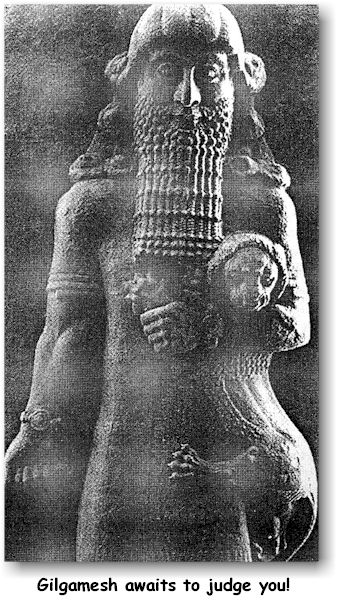
Passing by Ereshkigal, you enter a farther chamber, and at last come into the lordly presence of Gilgamesh. You will want to remember everything you have heard or read about him: the more you know about your judge when your case comes up, the better. The atmosphere is lighter here in the judgment chamber; torches ine the earthen walls, giving Gilgamesh's braided beard a ruddy glow. If you have been buried properly with good supplies, you will be able to offer him an appropriate gift (naked though you are, you still have your gifts with you): a richly ornamented dagger, perhaps, or a beautifully embossed shield. Ideally, you will have been making offerings to the semi-divine hero for some years now, and so Gilgamesh will recognize your name with approval. He may even smile. Ereshkigal's sobs may still be heard in the distance, but you suddenly realize that all will be well, or at least as well as can be. The gods cannot change your ultimate destiny, but in their severe mercy, they have appointed as judge the man most famous in history for his hatred of death, his longing for life, and his love of fellowship and beauty wherever they can be found. Like him, you may be granted a measure of life in the very palace of death itself.
From elsewhere in
the book (Note: “Bilgamesh” is an alternate spelling
of the more familiar “Gilgamesh”)
…Deeply aware that "whatever is acquired is destined to be lost," Shulgi was perhaps among the first to sense literature's power to help people face the unthinkable and imagine the unimaginable. One of the poems he commissioned was a somber account of the hero's death and burial. Lying on his deathbed, Bilgamesh has a dream vision in which the chief god Enlil tells him that the time is coming when he must leave his earthly adventures behind:
The darkest day
of mortal man awaits you now,
the solitary place of mortal man awaits you
now,
the flood-wave that cannot be breasted awaits
you now,
the battle that cannot be fled awaits you now,
the unequal struggle awaits you now,
the fight that shows no pity awaits you now!
Enlil urges Bilgamesh not to go down to the underworld with his heart knotted in anger; instead, he should unravel his clenched heart like palm fiber and peel it like an onion. For he will pass judgment and render verdicts in the netherworld, and there he will be reunited with his mother, his siblings, and "your precious friend, your little brother, your friend Enkidu, the young man your companion!" Feeling himself on equal terms with Enkidu, Shulgi must have taken heart at Enlil's words as well.
Over four thousand years old, "The Death of Bilgamesh" presents a fascinating mix of immediacy and distance when it is read today. The immediacy comes partly from the universality of its concerns, but also from the vivid language it uses to explore its theme. To protect his tomb from robbers, Bilgamesh has the course of the Euphrates temporarily diverted so that his tomb can be hidden in the riverbed. His workmen hasten to carry out his orders; once they have diverted the river from the desired stretch of riverbed, "its pebbles gazed on the Sun God in wonder. /Then in the bed of the Euphrates the earth cracked dry."
A modern poet could be pleased to have thought of the charming personification of the surprised pebbles, nicely contrasted with the realistic cracking of the riverbed under the sun's unaccustomed heat. Yet only a few lines later, the poem details an archaic burial scene of horrific strangeness, for Bilgamesh has himself interred together with a host of his family and attendants. Some had perhaps predeceased him and were now being buried with him, while others may have been slain for the purpose or else would be buried alive:
His beloved
wife, his beloved child,
his beloved senior wife and junior wife,
his beloved minstrel, steward and . . . ,
his beloved barber, [his beloved] . . . ,
[his beloved] attendants and servants,
[his] beloved goods. . . ,
were laid down in their places,
as if for a palace-review in the midst of Uruk.
Finally, Bilgamesh enters and lays himself down. His attendants then seal the tomb and release the barriers holding back the Euphrates: "its waters swept over, I his [resting place] the waters removed from view."
Today such a scene is most readily imaginable in the grim terms of a Jonestown massacre, but this was not at all the ancient poet's intention. The sense of cultural distance is only increased by the calm formality with which the Sumerian poet recounts Bilgamesh's funeral preparations.